

How Stealing and Enemy Drops Work
Stealing in Final Fantasy IX looks simple. Zidane uses the “Steal” command, and either he takes something or he does not. Underneath, the game is running two separate checks, and knowing how they work is the difference between farming a boss for an hour and getting what you want in a couple of minutes.
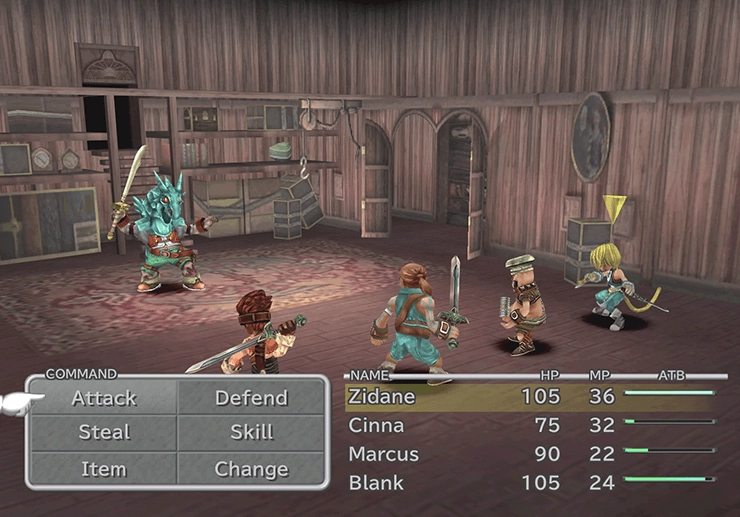
Every Enemy Carries Four Items
Each enemy has four steal slots:
- “Common”
- “Uncommon”
- “Rare”
- “Very Rare”
Plenty of enemies leave one or more of them empty. When Zidane steals, the game does not simply pick from whatever is there. It works through the slots in a fixed order, and that order is what makes rare items so painful to get.
Step One: Landing the Steal
Before any item is chosen, the game checks whether Zidane connects at all. It weighs his Level and Spirit against the enemy’s Level. If the steal does not connect, you will immediately see a “Couldn’t steal anything” message; Zidane does not even reach for an item. Higher level enemies are harder to connect with, which is why stealing from a boss feels so much worse than stealing from a random encounter.
The  Bandit ability removes this check entirely. With Bandit equipped, Zidane always connects. It is learned from the
  Mythril Dagger, which you can buy in Lindblum as early as Disc 1, making it the cheapest improvement you can make to stealing.
Step Two: Which Item You Get
Once the steal lands, the game rolls for the slots from rarest to most common and stops at the first success.
| Slot | The Roll | Chance of This Result |
|---|---|---|
| Very Rare | 1 in 256 | 0.4% |
| Rare | 16 in 256 | 6.2% |
| Uncommon | 64 in 256 | 23.3% |
| Common | Whatever is left | 70.0% |
Those four figures add up to 100%, and they are the odds of each outcome every time a steal lands. Note what that means for the “Common” item: it is not guaranteed. It is simply what you get when the three rarer rolls all fail, which happens about seven times in ten.
The Empty Slot Trap
Here is the part that trips up most players. The game rolls for a slot even when that slot is empty. If an enemy has nothing in its “Very Rare” slot and that roll comes up, Zidane steals nothing at all.
So an enemy carrying only a “Common” item will still leave you empty handed roughly 30% of the time, and no amount of patience changes it. That is not bad luck, it is simply how the mechanic works.
Master Thief Changes Everything
The in-game description for Master Thief reads “Steal better items,” which badly undersells it. What it actually does is put a floor of 32 in 256 underneath every slot, and skip empty slots instead of wasting a roll on them.
| Slot | Without Master Thief | With Master Thief |
|---|---|---|
| Very Rare | 0.4% | 12.5% |
| Rare | 6.2% | 10.9% |
| Uncommon | 23.3% | 19.1% |
| Common | 70.0% | 57.4% |
This means that a “Very Rare” steal goes from roughly one attempt in every 256 to roughly one in every eight, which makes it thirty-two times more likely to succeed. In practical terms, an item that could otherwise take you an hour of repeated attempts can often be obtained within a few rounds of combat, so you should always equip Master Thief before attempting any difficult steal.
Master Thief is learned from the  Thief Gloves, which you can win at the Treno Auction House or synthesize at Daguerreo. Both become available in Disc 3. Until then a “Very Rare” steal really is a one in 256 proposition, and nothing will improve it.
Mug and Steal Gil
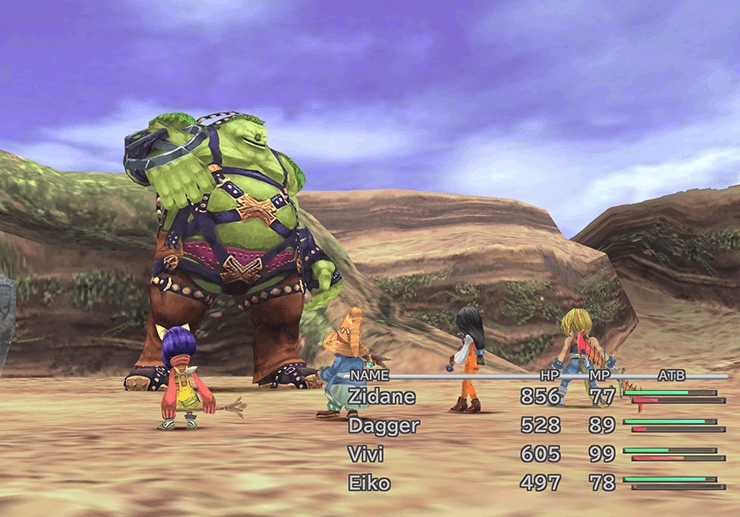
Mug causes Zidane to deal damage to the enemy each time he steals, and Steal Gil adds Gil to whatever he takes. Neither ability changes the odds of getting a particular item, so you should treat them as bonuses rather than as tools for hunting rare items.
Warning
Be careful about equipping Mug when you are hunting a “Rare” or “Very Rare” item. A steal in the “Very Rare” slot can take well over a hundred attempts without Master Thief, and the damage from Mug will very often defeat the enemy long before you succeed, which costs you the item entirely. Unequip Mug before you settle in to farm a difficult steal, and equip it again once you have what you came for.
How Enemy Drops Work
Drops follow different rules from steals, and they carry a quirk worth knowing before you grind for one.
Enemies have four drop slots as well. The “Common” slot is handled on its own: if there is an item in it, it always drops, and it drops once for every enemy you defeat. Kill three of the same monster and you get three of them.
The other three slots are handled together. The game checks them from rarest to most common and stops at the first success.
| Slot | Chance |
|---|---|
| Very Rare | 0.4% |
| Rare | 12.5% |
| Uncommon | 37.5% |
This means that a single enemy can drop up to two items: the “Common” item, which is guaranteed, and one further item from the “Uncommon,” “Rare,” or “Very Rare” slots.
The catch is that those three slots are rolled once per enemy type, not once per enemy. Fight two of the same monster and you will get two “Common” drops, but still only one chance at the rarer items. Piling extra copies of an enemy into a fight does not multiply your odds of a rare drop.
Drops have no accuracy check, so nothing can miss, and no ability improves them. What you see is what you get.
Tetra Master Cards
An enemy that carries a card drops it 12.5% of the time, and only one card can drop per battle no matter how many enemies you defeat.
Where to Find Each Enemy’s Items
Every enemy in the game has its steal list, drop list, and Tetra Master card documented in the Bestiary, with the real percentages already worked out for you:
Final Fantasy IX

Look up any enemy to see exactly what it carries in each of its four steal slots and four drop slots, along with its stats, elemental weaknesses, and the Blue Magic that Quina can learn from it. The Fang above is a good example: it is one of the first enemies you meet, and it fills all four steal slots.